
There is often much discussion in the shop with customers about what the most appropriate type of lead is. We would always recommend a standard 3 – 6ft lead or adjustable length training lead as being the most practical/ safest choice but thought it would be useful to try to provide an objective look at the pros and cons of the all the main types.
Standard flat nylon or leather lead/ rope lead
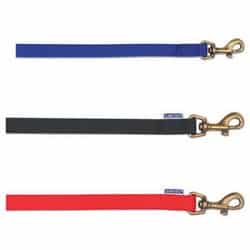 Standard style leads with trigger hooks generally vary from 3ft to 6 ft. If your dog is smaller you may wish to opt for slightly longer and it also depends on how much length you want to give your dog when out on walks. If it is slightly longer it can be a more useful aid for training heelwork/loose lead walking.
.
.
.
.
.
Training Lead (adjustable length)
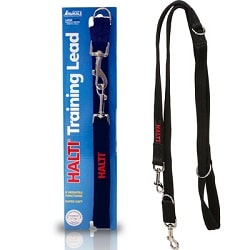 Allows your dog more freedom to explore & learn to make choices for themselves, whilst still allowing for closer control when adjusted to 3-4 foot length. Great for using with front attaching harnesses – clip one end to the front ring & one to the back, to balance your dog’s walking & help train not to pull, whilst taking pressure off the delicate neck area. Also great when used with head collars such as Haltis or Gentle Leaders, where again one end is clipped to the head collar & one to your dog’s regular collar for extra security (should the head collar slip off) & closer control for pulling/reactive dogs. These adaptable leads can also be clipped around your waist and be used to walk your dog hands free (great for eliminating tension on the lead which may be aggravating reactivity) or can clip onto a walking belt. They can also be used to walk 2 dogs at one time (attach one clip to each dog).
.
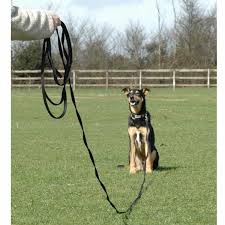 Long Lines come in a variety of lengths (anything from around 10 to 60 feet). We stock 5m (16 feet) and 10m (32 feet) long lines in the shop. Anything more than 10 metre can become extremely unwieldy. We often recommend that the 5m is sufficient for general recall training and to allow a bit of exploration safely. 10m lines or longer are often used for tracking/scent work training.
Long lines are often used as an aid when recall training as it allows you to create a bit of distance and to give your dog a bit of freedom whilst still maintaining control.
We would always suggest choosing where to use a long line carefully. If it is an area with lots of obstacles, shrubbery, trees etc it can get tangled. Open park space if best. It can also present a trip or tangle hazard with other dogs or people so best used in quiet areas.
We would also recommend using a harness with a long line or being very careful not to let your dog run to the end of the line quickly otherwise this can put strain on the neck/back and could cause injury.
They are not a practical lead for everyday use. They take a lot of winding up to give full control and would be risky in busy areas or by roads. They tend not to have a handle either.
Take special care when using these with large/fast breeds e.g. greyhounds, who can accelerate at great speed & cause injury to both themselves & you when they suddenly reach the end of the line & come to a halt with a jolt. For this reason, we would not recommend using a long line with a headcollar.
Another way these lines can be used is to let them trail along the ground behind your dog, with you stepping on the end to prevent your dog taking off when they reach the end – we recommend combining this with a recall cue so that your dog is given warning rather than coming to a stop with a jolt.
Flexi/Retractable Leads
 Flexi leads are very controversial and many dog trainers do not advocate their use. The number of reports of injuries/accidents with these types of leads is much higher than those with standard leads.
Flexi leads are not good for use when teaching your dog to walk to heel as they don’t teach them the feel of the end of the leash thus meaning dogs who are walked on them often don’t have good lead manners. They can send the dog confusingly mixed messages : sometimes you have to stay close; sometimes you can go 30 feet away. This plainly encourages dogs to pull frequently to test the distance allowed at any given time.
There is friction burns, wrap around risk to the dog, the walker and other dogs and members of the public if not used appropriately.
They are not recommended (especially by children) for use in built up urban areas with busy roads as they are easy to accidentally let out & cause an accident. We would recommend a standard 3 – 6ft lead or training lead as a safer alternative in these situations.
They are good for using in rural locations or areas free of other dogs/busy traffic/other path users, to allow dogs who perhaps don’t have adequate recall or cannot safely be let off lead around livestock a little more freedom, so long as you are always prepared to reel the lead in when you encounter others.
It is important to use correct size for dog’s weight. We recommend using tape rather than cord & 5 metres rather than 7 metres because this is safer in terms of injury to both you/your dog/the public & more visible to others (who otherwise may not realise your dog is actually on lead at all).
Slip Leads
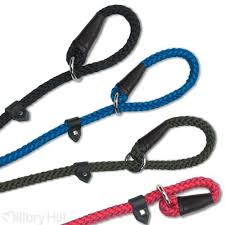 Controversial. Not suitable for dogs who pull because they tighten around their neck, essentially strangling them, whenever they pull. OK for dogs who walk on a loose lead. Popular with people who do gun dog training & other activities which require a dog to be quickly put on/off lead without fiddling with a clip/collar. Not suitable for long necked dogs like sighthound breeds due to the damage they can cause to structures lying within the neck such as the wind pipe & important nerves/blood vessels.
We would not recommend slip leads for “corrective” heelwork training as this can be painful and dogs will often still pull regardless. We have included some links to useful articles for alternative methods for loose lead walking training.
.
Kikopup loose lead walking video tutorial
Sophia Yin Article Loose Lead Walking Part 1 – choosing the right walking pace and make it clear
Sophia Yin Article Loose Lead Walking Part 2 – making about turns
Bungee leads
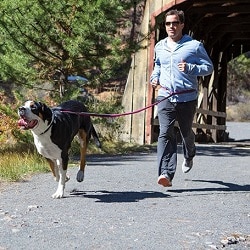 Not really suitable for use in dense urban areas where there is a lot of traffic & busy roads. Good for rural use to give dogs a bit more freedom whilst still on lead. Can absorb some of the shock from a dog pulling/lunging, minimising risk of injury to both dog & handler. Recommended for running with your dog because of this. Can often be attached to/wrapped around the waist for hands free walking/running. Not really suitable for reactive dogs (if used around the stimulus they are reactive to) because there is lack of close control. Not good for teaching loose lead walking because sends confusing messages to the dog.
.
.
.
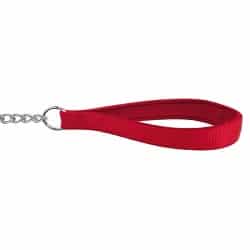 Good for dogs who chew nylon/leather leads! (Though NB the handle is still chewable!!) A bit heavy for some more delicate breeds, need to be careful not to accidentally injure dog with metal. Hard wearing.